
Key Skills Every Successful Nursing CV Should Include
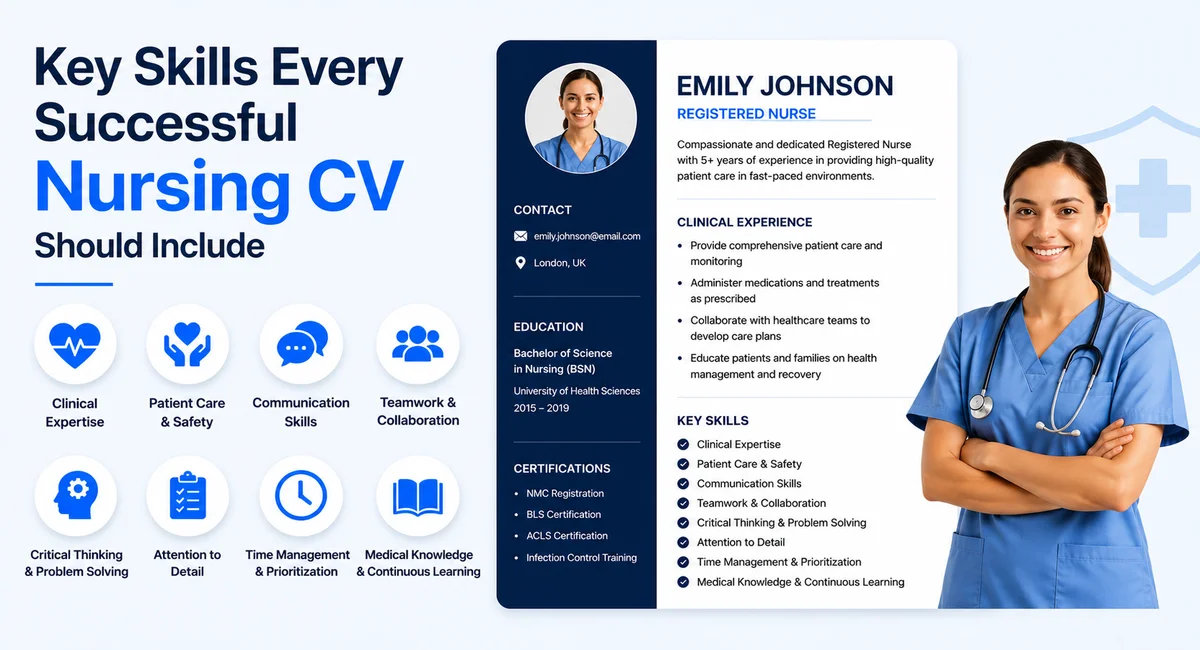
A nursing CV tells employers how you care for patients and respond under pressure. So if you’re applying for your first nursing position or looking to move into a specialist role, the skills you highlight can influence whether your application progresses to the interview stage.
Healthcare employers are often reviewing multiple applications for a single vacancy. A well-organised CV that clearly demonstrates relevant nursing skills makes it easier for recruiters to identify candidates who meet both the technical and interpersonal requirements of the role.
The key is to focus on skills that reflect your experience while matching the position you’re applying for. Continue reading to learn how you can do it the right way.
Why Skills Matter on a Nursing CV
Employers expect nurses to possess far more than clinical knowledge.
Modern nursing involves thinking and the ability to make sound decisions in challenging situations. Your CV should demonstrate these strengths through practical examples instead of simply listing them as keywords.
This is why you need to support your skills with achievements or responsibilities from your previous roles.
A lot of job seekers struggle to do so and search for the best nursing CV writing helper who can understand and list their skills the right way.
For example, rather than writing:
“Strong communication skills.”
consider explaining how you:
“Educated patients and family members on post-discharge care, improving treatment compliance and patient satisfaction.”
These specific examples give employers greater confidence in your abilities.
1. Clinical Skills
Clinical competence is still one of the first areas recruiters evaluate.
The exact skills will depend on your specialty, but common examples include:
- Patient assessment
- Medication administration
- IV therapy
- Wound care
- Electronic health records (EHR)
- Infection prevention
- Vital signs monitoring
- Patient documentation
- Emergency response
- Care planning
Make sure to avoid listing every procedure you’ve ever performed. Instead, prioritise the skills most relevant to the vacancy.
2. Communication Skills
Nurses communicate constantly with patients, families, physicians, and fellow nurses.
Clear communication reduces errors and supports stronger teamwork.
This is the reason employers value candidates who can:
- Explain medical information clearly.
- Listen carefully to patient concerns.
- Document accurately.
- Provide compassionate support.
- Communicate effectively during handovers.
These abilities become especially important in busy clinical environments where misunderstandings can affect patient safety.
3. Critical Thinking and Decision-Making
Healthcare environments change quickly. You will observe healthy patients deteriorate unexpectedly and patient care priorities changing throughout a shift. As a nurse, you should be able to make informed decisions with limited time.
Your CV should demonstrate situations where you:
- Recognised changes in patient condition.
- Chose to raise concerns appropriately.
- Prioritised competing responsibilities.
- Took an efficient approach to solve problems.
- Supported safe patient outcomes.
Employers want evidence that you remain calm while making sound clinical decisions.
4. Teamwork and Collaboration
Nursing is rarely an individual role as patient care depends on cooperation between multiple healthcare professionals.
Recruiters appreciate candidates who can:
- Collaborate with multidisciplinary teams.
- Show support to colleagues during busy periods.
- Share information effectively.
- Contribute to positive workplace culture.
- Mentor junior staff or nursing students.
Showing that you work well with others demonstrates professionalism as well as leadership potential.
5. Time Management and Organisation
A typical nursing shift involves balancing patient care, documentation, medication schedules, admissions, discharges, and unexpected emergencies.
Strong organisational skills help nurses manage these responsibilities while maintaining high standards of care.
Try to highlight examples where you:
- Managed multiple patients effectively.
- Met documentation deadlines.
- Maintained accurate records under pressure.
- Coordinated patient care with different departments.
- Easily met urgent clinical needs.
This is because employers value nurses who can remain organised even during demanding shifts.
6. Compassion and Emotional Intelligence
Clinical knowledge is essential, but compassionate care is equally important.
Patients often remember how they were treated just as much as the treatment itself.
Demonstrating empathy helps build trust and improves the overall patient experience.
Your CV might show this through examples such as:
- How you supported anxious patients before procedures.
- The way you assisted families during difficult situations.
- Your participation in providing patient-centred education.
- How you advocated for patient needs.
These examples help employers see the person behind the qualifications. If you are still confused about how to present these examples, you can always consult a writer from a reliable and cheap CV writing company.
7. Adaptability
Healthcare is changing through updated clinical guidelines and increasing patient needs. This has elevated the demand for nurses who can adapt quickly.
Recruiters often look for candidates who:
- Have learned new healthcare systems.
- Can easily adjust to changing patient priorities.
- Work across different clinical settings.
- Know how to respond effectively during emergencies.
Showing flexibility demonstrates that you’re prepared for the realities of modern healthcare.
8. Leadership Skills
Leadership isn’t limited to nurse managers, as many staff nurses demonstrate leadership every day by guiding colleagues and supporting new employees.
Examples include:
- Supervising nursing students.
- Leading quality improvement initiatives.
- Coordinating multidisciplinary care.
- Acting as charge nurse during shifts.
Even informal leadership experiences can strengthen your application.
Match Your Skills to the Job Description
One of the simplest ways to improve your CV is to customise it for each application.
Review the job advertisement carefully and identify the skills the employer emphasises.
If you genuinely have those abilities, make sure they’re clearly reflected throughout your CV.
For example, if the employer highlights patient education or electronic medical records, include relevant examples from your own experience rather than relying on generic statements.
A targeted CV is more effective than sending the same version to every employer.
FAQS
- How many skills should I put in a nursing CV?
You can include up to eight to twelve skills relevant to the job to demonstrate your proficiency in the profession.
- Do newly graduated nurses have to include transferable skills?
Yes, because your clinical practice and academic assignments usually offer great examples of transferable skills such as communication skills, teamwork, patient care and time management.
- What is the most frequent mistake of the nurses while stating their skills?
The most frequent mistake is stating the skills without giving an example of how you applied them. Your focus should be on supporting those skills with their practical application in your resume.
Wrapping Up
The ideal nursing CV incorporates clinical skills as well as those attributes which make you an outstanding candidate from the point of view of the prospective employer. Your credentials and experience matter, but your ability to connect and provide compassionate care to your patients does a lot more for increasing interview chances as well. Thus, you must showcase your skills and support them through examples in order to develop an effective nursing CV.

I help professionals stop underselling themselves and start getting noticed. Through strategic CV writing and career coaching, I turn overlooked profiles into strong, confident applications that lead to real interviews and offers.